On Knowing When to Leave
The manager called me in.
I already knew.
I’d known for weeks, in the way you know something before you’re willing to say it out loud.
The conversation was ten minutes.
The decision had already been made, by both of us, long before that.
I’ve left three jobs carrying the same feeling: that I’d failed at something, and that leaving had confirmed it.
Three times, same shape, same emotional aftertaste. That is a pattern. And understanding the pattern is cheaper than repeating the experiment.
The narrative we inherit
The script runs like this: quitting is for people who couldn’t hack it. Persistence is the virtue; exit is the failure.
You stay, you push through, you prove something. To whom is never quite specified.
Steven Bartlett names it directly in Happy Sexy Millionaire :
They trap you in the toxic narrative that quitting is a weakness, an easy way out or, worse yet, that quitting is failure. I assure you, quitting is for winners and quitting is a skill.
He’s right, and I read it too late.
The narrative is remarkably durable. It survives promotions, salary reviews, and even long stretches of genuine misery, because it reframes all of that as evidence of your commitment rather than the cost of your reluctance. It cost me nearly a decade in one job and three years in another, before someone else’s decision made the third exit for me.
The Dip, the Cul-de-sac, and the Cliff
Seth Godin’s The Dip gives this problem a taxonomy. Three situations, three names.
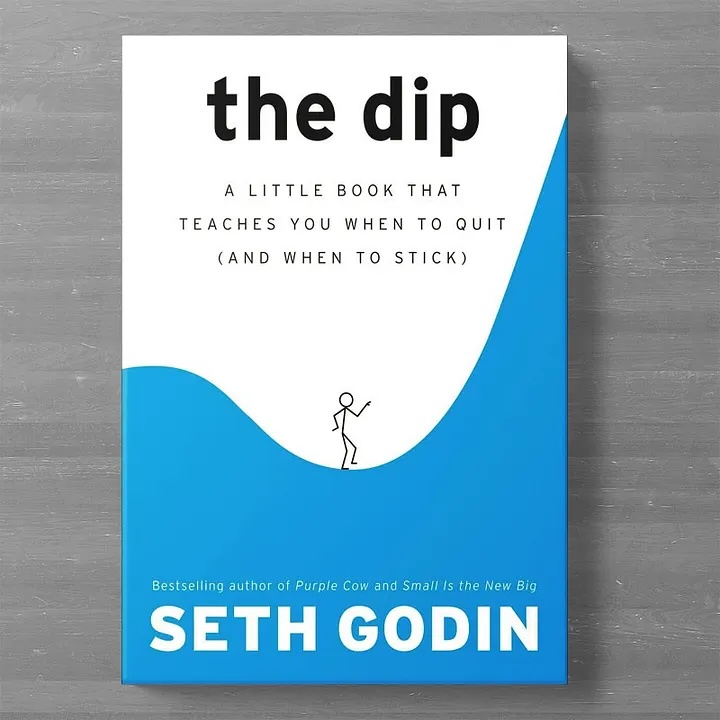
The Dip is a temporary hard patch. The payoff isn’t visible yet, the difficulty is real, and the temptation to quit is highest just before the breakthrough. Every success story has one.
The Cul-de-sac is a dead end. The path will not take you where you need to go, regardless of how long you stay on it. Staying looks like grit. The cost compounds.
The Cliff looks fine until it doesn’t. Viable, then suddenly untenable.
Godin argues that winners quit the right things at the right time, and the taxonomy is genuinely useful, but only in hindsight. A Dip that’s genuinely hard looks identical to a Cul-de-sac when you’re inside it, and identifying which one you’re in requires the very judgement the situation is designed to impair. The framework gives you the vocabulary to describe what happened after the fact. It doesn’t hand you the clarity to act in the moment.
Those are different tools.
Stewart Butterfield quit two projects before anything worked. He left Game Neverending to build Flickr, then Glitch to build Slack. Both exits looked like failure at the time. What he had done was recognise a Cul-de-sac before full collapse.
The next thing wasn’t the original plan, it was what he found after clearing the wreckage.
Three exits
The first was a consulting firm. Almost ten years. The routine had installed itself so quietly I barely noticed: same problems, same constraints, same conversations with different people pretending they were new. The culture had a gap between what it said about itself and how it actually ran, and the longer I stayed, the wider that gap looked. In hindsight it was a Cul-de-sac, confirmed nearly a decade too late. The sunk cost mechanism is elegant in how it works against you: the longer you stay, the more evidence you accumulate that leaving would be a waste. The math is always wrong. The feeling is always real.
The second was a scale-up. Three years trying to build architectural foundations in an environment that didn’t want them. The organisation ran on the conviction that confidence was indistinguishable from competence, and by the time I arrived it had been running that way long enough that nobody could tell the difference any more. The problem with a culture like that is that you can’t fix it from the inside, because the inside can’t see the error. I couldn’t get buy-in on the basics. Another Cul-de-sac, structural this time.
The third was a bank. Sharp hiring manager, immediate understanding, good start. Then he moved on and his replacement was the opposite: chaotic, imprecise, someone who manufactured political games in a place with no politics worth playing. Four months in, he pushed me out. That one was a Cliff: fine until the conditions changed, then untenable fast. By the time it happened, I had already left in everything that mattered.
What they share
In all three cases, the signals arrived long before the decision: the formal conversation, the manager’s call, the ousting. Long before any of that, something had already shifted.

Angela Duckworth’s Grit argument pushes back here: her research shows we quit too early, especially at the point of maximum difficulty, which is also the point just before a breakthrough.
That’s a real phenomenon, but it misses the selection effect.
We only hear from people who persisted and succeeded. The people who stayed through a genuine Cul-de-sac and lost years to it don’t write bestsellers about it. The sunk cost of time keeps people in dead ends the future has already closed.
The signals I read late, or suppressed entirely: detachment first, the quiet withdrawal of investment while still showing up.
Then fatigue, the grinding cost of pushing against something that won’t move.
The first two are easy to suppress: detachment feels like professionalism, fatigue feels like hard work.
The third, the self-questioning, is however harder to dismiss: the doubt that starts as “is this the wrong fit?” slowly becomes “am I the wrong person?”
By then, you’re actively arguing against your own intuition with the evidence the environment has been building for months. That’s impostor syndrome, manufactured by the wrong environment rather than earned by your own performance.
Closing
Quitting is a skill. Bartlett is right about that, and like most skills, you only understand it by practising it badly first.
The cost of the first two was measured in years. The third I had already decided before anyone told me. In every case, the signals had been there from the start, and in every case I had constructed perfectly reasonable arguments against acting on them: sunk costs dressed up as commitment, loyalty extended past the point where the organisation had earned it, and the fear of being the one who quit.
That’s a different fear from the fear of failure. It’s the fear of being seen leaving.
The signals always arrive before the decision.
The only real question is how much more time you spend proving you shouldn’t trust them.