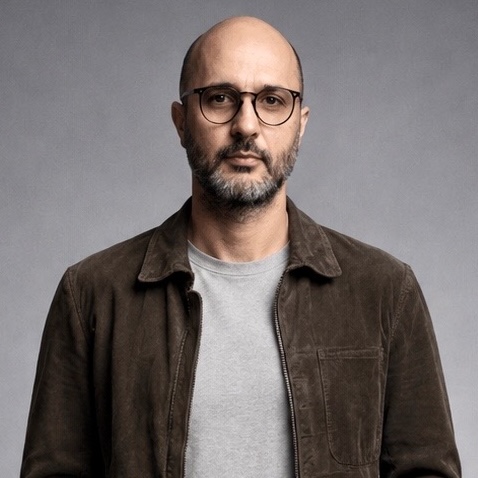
The hobby I used to love, the job I started to hate

I’m 14, and I’ve already chosen what to do the rest of my life. Next year, the Tunisian educational system will ask me to pick a stream: maths, science or literature.
Nobody needs to ask. It’s maths, because maths leads to engineering school, and engineering school leads to computers.
I know nothing about salaries, job markets or what a software engineer does all day. But all I know is that it’s the path to follow to my dream job.
Six years earlier, a showroom computer answered my first line of code with SYNTAX ERROR, and I haven’t stopped arguing with machines since.
Paid to play
I’ve already told the showroom story : an 8-year-old dragged to the shopping centre, a cold machine he couldn’t talk to, and a salesman who knew even less about it than he did.
From that day, I spent hours, then days, trying things and breaking them. Any book, any magazine article, any program listing or discussion about computers, I took it. Nobody asked me to, nobody graded it.
While other kids my age discovered football, girls, or both, I discovered that a box with 64 kilobytes of memory would obey me if I asked it properly, and I considered this the single greatest achievement of the human race. (I still think it’s in the top ten.)
I loved it. I felt alive.
Everything went exactly as the 14-year-old had planned: maths, engineering school, the diploma 25 years ago, and the dream job, straight away. Somebody was paying me to do the thing I used to do for free, and to keep learning while doing it.
For a while the hobby and the job were the same thing, and I couldn’t believe my luck.
Fred Brooks had described that feeling back in 1975, in The Mythical Man-Month.
First, “the sheer joy of making things”. Then the pleasure of making things that are useful to other people. And the joy of always learning, because no problem is quite the same as the last one.
I had all of them, every day.
He also listed the woes of the craft, on the same page. But naïve as I was, I skipped that part.
The woes were for people who had been around much longer than me.
It took me years to go back to that page, and by the time I did, I had become one of those people, with the joy already starting to fade.
Same problems, new words
The fade came quietly, without one project or one manager to blame. At some point I noticed I had stopped caring about what I was doing.
Some mornings I hated it, and then I hated myself for hating it.
Meetings looked alike.
Problems looked alike, the same ones coming back every few years, dressed in new words.
Brooks promised that no problem is quite the same as the last one. Either that stopped being true, or I stopped being able to see the difference.
I still don’t know which one scares me more.
What I could see was how much the job itself had changed. When I started, software engineers were a rare resource. You had to be slightly obsessed to end up there, because there was no other reason to go through it.
My brother put it bluntly one day: “It’s a job now, without any prestige or rarity.” He’s right, and that part doesn’t bother me. More people got the chance I had.
What bothers me is how the industry fills the seats. I’d be lying if I said I only watched, because I filled some of them. I’ve worked in teams sized by the contract, where the problem had to fit in afterwards. I’ve watched people get rewarded for launching things, then move on long before anyone switched those things off. And I’ve watched complexity pile up, layer after layer, because complexity looks like seniority.
Some of those diagrams are mine, and so are some of those layers. I was good at it.
None of it was new, even then. When I was recruited as a “rare resource”, the bookshops were full of Teach Yourself Java in 21 Days, and Peter Norvig was already answering that it takes ten years . Maybe it was always like this, and I only see it now because I’ve been here long enough.
All of this has a price: budgets and years of work, and whole careers, mine included. For a long time I assumed it ended up somewhere useful, in systems people relied on and that would outlive the projects that built them.
Then I started counting.
Digital dust
The first system I built was switched off eight years after it went live. A colleague called me to tell me the news. I still remember that call, and I still remember the long nights the system had cost me. I remember them as clearly as the system itself.
It was a customer care system we built in-house for a telecom operator, to manage landline subscriptions, from the customer’s request all the way down to the telephone exchanges.
One day, we got an unexpected thank-you from a clerk in one of the operator’s shops, the kind where people come to order a line or ask about an offer.
Before, tracking a customer meant days of faxes going back and forth. Now it took a few minutes. That was Brooks’s second joy, making things that are useful to other people, and I had it.
It was still working when it was switched off, like every system I built after it. In its case, the operator had changed everything underneath it: the telephone exchanges, and with them the processes and the commercial offers.
There was nothing left for it to serve.
I’d like to believe those minutes still count somewhere, even when nobody remembers them.
Most days, I’m not sure they do.
It happened again, and again, and each time it felt normal.
When I add it up, the systems I’ve built lived about six years on average. Over 25 years, that’s four generations of my work switched off or migrated into something else, and some of it quietly forgotten.
Most of them went with the people around them, usually a new leadership that wanted a system of its own, sometimes a reorganisation or a merger.
Very few of them still run today.
Even so, mine were the lucky ones. Around me, I’ve seen systems specified for a year, built for two, and barely used before the next strategy made them pointless.
The rest of mine must be somewhere in an archive. A repository nobody opens, a backup nobody will ever restore, and a few commit messages with my name on them, which is all the trace I left.
The page I skipped from Brooks listed that ending too: the product that “appears to be obsolete upon (or before) completion”. I thought it was a warning. It turned out to be a description.

And then, I remembered a film, Kodachrome, where Ed Harris plays an ageing photographer, dying, who makes one last road trip to develop his final rolls of film before the last lab able to process them closes. He’s afraid that one day, when they dig us up, there won’t be any pictures left to find. At one point he says:
People are taking more pictures now than ever before, billions of them, but there are no slides, no prints. Just data. Electronic dust.
Replace pictures with systems, and that’s my career: digital dust.
More dust, faster
And now a machine arrives that can produce all of this faster.
I don’t fear AI. I use it, I build with it, and some days it gives me back a piece of the hobby. I built my own training agent with it, just for me, and for a few evenings I was 8 again, arguing with a machine. Kent Beck wrote that 90% of his skills were now worth $0 , and the other 10% worth a thousand times more. He’s probably right, and yet I keep looking at the 90%.
But I’ve seen this film before. Every tool that makes software cheaper to produce ends the same way in this industry. We make more of it, and we switch it off sooner. I didn’t say it in my last post about AI , but much of what we build was already throwaway, long before AI. Profit was already ahead of value. I’m afraid it just got a production line, and the dust will only pile up faster.
The farmer joke
There is an old joke about where a developer’s career ends.
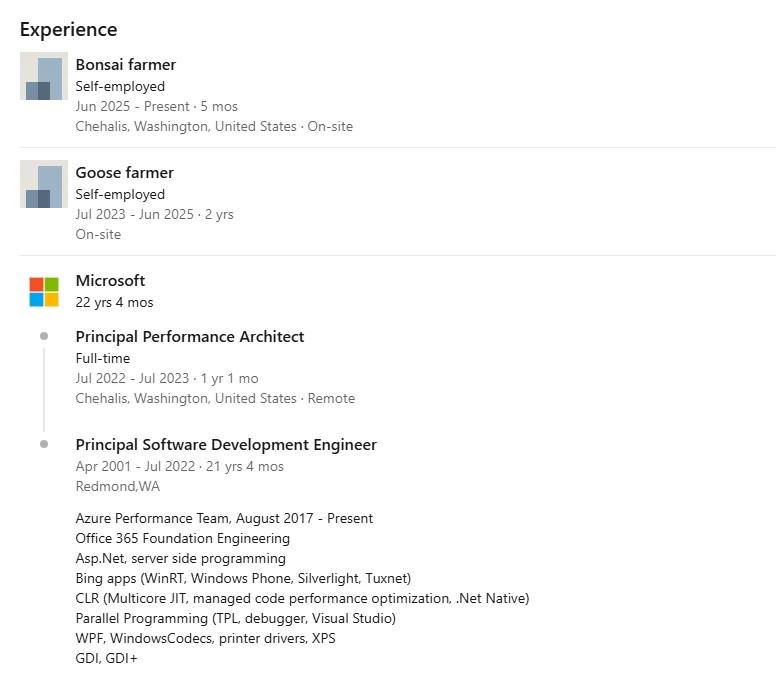
I used to laugh at that joke. I even threatened to become a sheep farmer once, half-joking. Now I understand it.
Part of it is the climb itself. Every step up took me a bit further from making things and a bit closer to meetings where nothing gets made. I climbed away from the thing I loved, and called it a career.
The other part took me longer to admit. Miya Tokumitsu named it :
Nothing makes exploitation go down easier than convincing workers that they are doing what they love.
I loved it, so I accepted everything that came with it. I worked nights and weekends, I cut holidays short, and little by little I saw less and less of my friends.
One picture stays with me. My second child was a few months old, I was working for an important bank, and one day the nanny was unavailable. So I worked from home, and my son slept on my arm while I was in a meeting.
And when the joy started to fade, I blamed myself long before I blamed the job.
Some would call all of that a midlife crisis. If it is, I’ve stopped fighting the word.
I often think about that 14-year-old, so sure of the path to his dream job. I wouldn’t change his choice, but I would make him read the page he’s going to skip: the job will wear out, most of what he builds will turn to digital dust, and the only part nobody can switch off is a kid arguing with a machine, for nothing.
After a long time on the field, I still love the hobby, but I’ve stopped waiting for the job to give it back, and I’ve started looking for it somewhere else.